
Yoko Shimomura x Michiru Yamane (2023)
This massive interview with Yoko Shimomura and Michiru Yamane originally appeared in the book Game Ongakuka Interview Shuu, released in 2023 and authored by renowned gaming journalist Haruhisa "hally" Tanaka. A musician and engineer himself, Tanaka centers the conversation on Yamane and Shimomura's classical music roots, exploring their formative influences with unprecedented nuance.
Yoko Shimomura - Born in Hyogo Prefecture. Studied piano and composition at Osaka College of Music Junior College Division, joining Capcom in 1988. She primarily composed arcade game music, including Street Fighter II, and performed live as a member of Capcom's in-house band, Alph Lyla. She joined Square in 1993, working primarily on RPGs, most notably the Live A Live and Kingdom Hearts series. She went freelance in 2003 and has since composed for anime, films, and stage productions.
Michiru Yamane - Born in Kagawa Prefecture. Majored in composition at Aichi Prefectural University of the Arts, studying under the late Bin Kaneda. While studying Western classical music, she discovered computer music production. She joined Konami in 1988, composing music for numerous titles, including the Castlevania series. Later, she studied jazz and polyrhythms at Makoto Kikuchi's private school, integrating these elements into her game scores. She left Konami in 2008 and currently focuses on healing music.
—When did you two first cross paths?
Shimomura: It was in 2008. I believe I paid a visit to the Konami offices.
Yamane: I was thinking about leaving the company around that time, and I wanted to talk to Shimomura as someone who had already gone freelance, so I reached out to her. I think I first learned about Shimomura through Kingdom Hearts. I used to read her blog all the time back then, and I really admired her flexibility and initiative.
—Yamane, how did you end up joining Konami in the first place?
Yamane: I had graduated from music school and was about to secure a position as a part-time teacher at a local high school, but I really wanted a job where I could write music. There weren't any job openings, so I was close to giving up, but then I found Nihon Computer System and Konami. Konami's entrance exam was scheduled earlier.
I've always loved games. Back in high school, I was so hooked on Space Invaders that I practically ruined my eyesight. Even during university, I would constantly visit a friend's boarding house because they had a Famicom. I thought Konami looked like a great place, so I took the exam, and that very same day they called to schedule an executive interview. During our training, we had to study things like the Z80 CPU and general computer architecture. Once I actually started working, it was nothing but composing.
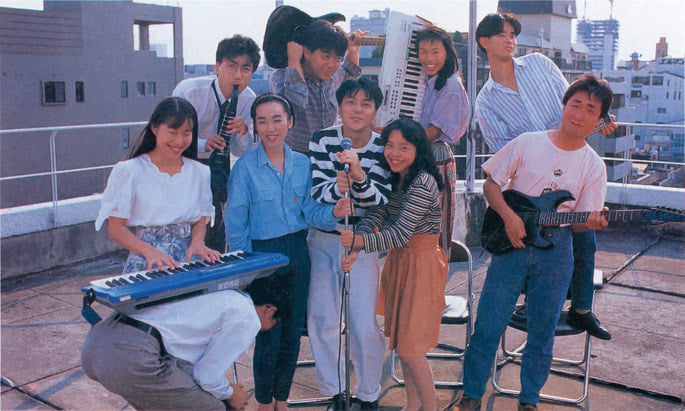
Shimomura: I had to do assembly programming too! I see so many parallels to my own story. I was on track to secure a position at a piano school, but I suddenly found myself wondering, "Is this really what I want?" I loved video games and saw a recruitment listing, so I originally applied to Nintendo, but it wasn't a good fit. I thought Konami looked great too, but they didn't have any openings—though they were hiring part-time staff. (laughs) The only one left was Capcom. Come to think of it, I had actually worked a part-time gig at a Capcom event booth the year before, handing out flyers for the Famicom version of Ghosts 'n Goblins. I thought, "Ah, that place!" and applied. That was in 1988.
Yamane: Wow, we're exactly the same. I joined in '88 too.
—What led you to pursue composition in the first place?
Yamane: I had been taking lessons in piano and electone since I was a child, but my teachers were incredibly strict about never making a single mistake. Then, during a middle school performance, I got so nervous that my mind went completely blank and I couldn't play at all. Ever since that moment, I became absolutely terrified of playing in front of people, which made me want to write music instead. With composition, even if you make a mistake, you can just wipe it away with an eraser.
Shimomura: That's incredibly similar to my experience. I was a piano major in college, but I wasn't good at all. I grew terrified of messing up during performances, and I also realized that I couldn't physically play the ideal piano music I was imagining in my head. If I couldn't play it, I thought, I should just switch to the writing side and let professionals play it for me. I used to worry that turning to composition just because I couldn't cut it at the piano was disrespectful to dedicated composition majors, but in the end, it worked out for the best.
Yamane: At first, computers were so much fun because as long as you put in the time, they would play any phrase exactly how you wanted without a single mistake. I was thrilled to be able to build my own ideal worlds without having to perform them. I only recently started playing the piano myself again. Right before I left Konami, I was asked to play the harpsichord at a game show in Germany. By then, my mindset had shifted, and I was getting burned out on sequencing music anyway, so I finally gave myself permission to play. When I finished playing at the venue, the crowd erupted into a huge cheer, and that was the moment I thought, "Yeah, I think I'm done with the corporate life." Though it wasn't until around 2016 that I started playing in front of crowds regularly again.
Shimomura: Classical music really hammers home that standard of perfection. "You must not make a mistake."
Yamane: I actually attended a music high school before university. I only chose it because I didn't want to go to a regular academic school and spend all my time studying. Once I enrolled, everyone around me was incredibly talented at the piano, so I was already afraid of performing back then. It was after that, remembering the middle school incident where I froze up on the electone, that I started taking music theory and harmony lessons, setting my sights on the composition department for university.
Shimomura: I wanted to go to a music high school too, but my piano skills were nowhere near that level. I'm envious that you had the chops for it. I always say this, but if I'm reborn, I want to be a pianist. (laughs)
Yamane: If I'm reborn, I want to be a jazz pianist. I really admire them.
The Shared Experience of the TV Generation
—Considering how close you are in age and background, I imagine you listened to a lot of the same music.
Yamane: Where should we start? Yellow Magic Orchestra?
Shimomura: When I was in high school, I was hospitalized for appendicitis. A friend brought me a YMO album with Snakeman Show comedy sketches interspersed between the music. "Listen to this to cheer yourself up."
Yamane: That must have been Zoushoku.
Shimomura: I had just had surgery, but it made me laugh so hard. "Hahaha! Ow, it hurts!" That's my main memory of YMO. (laughs) That friend was a Haruomi Hosono fan, and another friend loved Yukihiro Takahashi, so I felt like I had to say I liked Ryuichi Sakamoto. (laughs) From there, I went backward and checked out YMO's catalog and a bit of their solo work. I wouldn't say I was obsessed, but everyone from our generation passed through that phase.
Yamane: My absolute favorite is Ryuichi Sakamoto's solo debut, especially Thousand Knives. I listened to that and the Kakutougi Session album Summer Nerves on heavy rotation. There were chord progressions in Thousand Knives that I couldn't figure out by ear, which made it all the more fascinating. When I can't figure out a progression for a song I love, it leaves a massive impression on me. That album deeply influenced me.
Sakamoto's arrangement work for artists like Eikichi Yazawa, Circus, and Taeko Onuki was also brilliant; he really stood out. I respect him so much. Honestly, my shift to the composition department was largely due to Sakamoto's influence. I wanted to be just like him. To achieve that, I went to study composition theory under a teacher who had graduated from Tokyo University of the Arts. That teacher's time at the university slightly overlapped with Sakamoto's, which alone made me so happy and motivated me to study.
—So your introduction to YMO came strictly through Ryuichi Sakamoto.
Yamane: I think I discovered YMO only after becoming obsessed with Sakamoto. I had the track Tong Poo on heavy rotation. I listened to every single artist he mentioned in his interview articles—people like Steve Reich. That led me to Japan, and I listened to Tin Drum to death. I grew to love Kraftwerk too. I even listened to contemporary classical music, thinking, "Sakamoto must have studied things like this." I listened to Akiko Yano through that same connection, and I remember being devastated when they got married. (laughs) That's how big of a fan I was. But during my time at Konami, I never mentioned any of this to anyone around me. I thought they'd just think, "Wow, what a nerd." It's not like that anymore, though.
Shimomura: Speaking of YMO, I loved the song La Femme Chinoise. I found it incredibly interesting how they took ethnomusicological elements and infused them into pop music. They didn't just copy it; they digested it into their own style. In that sense, they might have influenced me down the line.
—That feels like a direct precursor to your work on Street Fighter II.
Shimomura: Their sound was so pop-heavy that I almost felt guilty liking it. (laughs) I had a strict classical upbringing, but up to a certain point, I listened to popular Japanese kayōkyoku music just like anyone else. When I was a little kid, I was singing along to Hideki Saijo's Jonetsu no Arashi when my father snapped at me, saying, "Stop singing such disgraceful songs." After that, my interest shifted to the piano, and I moved away from pop music for a while. But in the sixth grade, I was blown away by Crystal King's Daitokai, which brought me right back. I started watching music chart shows like The Best Ten. The very first records I bought with my allowance were Daitokai and Saki Kubota's Ihoujin. I was also heavily into Godiego back then.
Yamane: My introduction to pop music came through television, with things like Seiji Tanaka's Beautiful Sunday or Megumi Asaoka. I listened to Twist too. A bit later on, it was Seiko Matsuda. Television also got me into foreign film scores. I'll never forget Henry Mancini's theme for Columbo, with that striking whistling sound. I also loved the ending themes for programs like Monday Road Show and Friday Road Show—things like Ray Anthony's The Party's Over or Pierre Porte's Cris d'amour.
Shimomura: I absolutely adored Morton Gould's arrangement of So in Love, which served as the ending theme for Sunday Foreign Film Theater.
Yamane: Oh, I loved that one too!
Shimomura: My Dad would call out to me, "Your favorite song is playing!" and I would run to the TV just to catch that specific piece. At first, I thought it was Rachmaninoff, but then I realized, "No, this feels more modern," and searched for the recording much later. Speaking of movies I watched on TV back then, the theme from Gone with the Wind, Tara's Theme, was unforgettable. I also really loved Lawrence of Arabia. I had absolutely no idea what the plot was about, but my fascination with Middle Eastern sounds definitely traces back to that theme song. That material is undeniably part of my musical roots.
Awakening to Western Music
Yamane: When I was in fifth or sixth grade, our family finally got a stereo system. I listened to the included LP records constantly—Oscar Peterson's jazz and Julio Iglesias. At home, since my mother ran a cosmetics retail shop, door-to-door salesmen selling imported records would often drop by. My parents loved music, so they bought them regularly, which is how I got exposed to European pop. That's how I discovered Nini Rosso's Il Silenzio.
Shimomura: We had Nini Rosso records at our house too, along with Claude Ciari, because my father loved them.
Yamane: Eventually, I started buying records myself. The first ones were by the Bay City Rollers. Between the Beatles and the Bay City Rollers, I was firmly in the Bay City Rollers camp.
Shimomura: They were incredibly popular, weren't they? If you bought magazines like Heibon or Myojo, they always came with their posters. Even though I bought them, I'd act all cool and pretend I wasn't interested. (laughs)
Yamane: Later on, I started reading Music Life and discovered Angel and Queen. I listened to pretty much all the Western rock music of that era, reading Yoichi Shibuya's liner notes. I also recorded music off the radio all the time. To list the artists I got into that way: Billy Joel, Barry Manilow, Burt Bacharach, and Eric Carmen. Carmen famously incorporated Rachmaninoff into All by Myself, and the piano phrasing in the middle left a huge impression on me. I also fell in love with a love song called Just Once from Quincy Jones's album The Dude and listened to it constantly. That and Michael McDonald's song What a Fool Believes. A lot of people have covered that one. It was another song where I couldn't figure out the chord progression. I definitely had that one on heavy rotation too. As for instrumental tracks, I liked tracks like Barry White's Love Theme.
—So back then, if a hit song resonated with you, you'd listen to it no matter what?
Yamane: Exactly. A bit later on, it was things like The Knack's My Sharona and Chic's Le Freak. I even listened to a bit of punk rock like the Sex Pistols. After that phase, I pivoted to dance music and New Romantic styles—M's Pop Muzik, Depeche Mode, Yazoo, Boy George, Panache, Duran Duran…
Shimomura: If you were recording music off the radio back then, you absolutely could not escape Duran Duran. For our high school bunkasai (cultural festival), we actually made Duran Duran costumes, put their music on, and mimicked their choreography. That's how much we loved them. I also really liked Roger Taylor back then. That's the trajectory I took: from the Bay City Rollers to UK music, which eventually led me to Queen. I've always loved UK music.
Shimomura: How about the Pet Shop Boys? I loved them.
Yamane: Oh, definitely. I listened to them too.
Shimomura: My interest in Western music came pretty late, right around when Michael Jackson blew up. Before that, it was strictly classical music and a few Japanese pop songs. My father was quite strict about music and disliked Western music and rock.
Yamane: Our house was the exact opposite. When I was small, my mother would watch bands like Yes or Elvis Presley on TV and record the audio onto cassette tapes. That's what got me into Western music. It's surprising to hear that you didn't go through a rock phase as a kid, Shimomura. Considering your work on games like Street Fighter II, you write rock-styled tracks so effortlessly.
Shimomura: Not at all! I barely knew left from right; I just somehow managed to scrape my way there. The whole reason I thought about trying game music in the first place was because I heard Dragon Quest and thought, "If it's classical-styled music like this, even I might be able to do it." (Sorry Sugiyama Sensei!!) But at the time, Capcom wasn't making RPGs, so I had no choice but to write action game music. When I first joined, I couldn't write a single line for bass or drums.
Yamane: I was exactly the same when it came to writing for action games. I didn't know how to program drums at all, so it was a massive struggle. On top of that, the entire concept of using a seventh or major seventh chord as the tonic (the opening chord of a song) never even occurred to me. In academic music theory, they only ever taught us that the tonic was a standard C major triad, do-mi-so. I ended up listening to older titles like Exciting Soccer to see how my seniors did it, realizing, "Oh, you can do it like this!" That blew my world wide open.
A Purely Classical Upbringing
—Shimomura, you mentioned having a "purely classical upbringing." How did that come about?
Shimomura: I've always loved the piano. In elementary school, I would use my allowance almost every month to buy individual sheet music pieces that cost about 150 yen each. Seeing that, my father gave me a classical masterpiece cassette collection for my birthday that featured those exact pieces. For a long time, that tape was the only recorded music I owned, so I listened to it exclusively. But eventually, I started diving into my father's classical record collection, and that's when I truly got hooked.
By the time I was in middle school, I'd listen to pop music but walk around with this slightly insufferable attitude like, "Sure, but my favorites are Ravel and Rachmaninoff. I'm not like the rest of you." (laughs) I listened to a wide spectrum from the Romantic era to early modernism, but I didn't care much for Classical era composers like Mozart or Beethoven. I was just far too deeply in love with the Impressionists. I can appreciate other genres and think they sound cool, but at my core, I'm a classical nerd through and through. Even today, if I think about what to listen to before going to bed, it's always classical music.
Yamane: How do you feel about Chopin? I'm particularly fond of his Piano Sonata No. 3 in B minor.
Shimomura: I love Chopin. The final movement of the third sonata is one of my top two favorite piano pieces of all time. The opening is spectacular; it gives me chills. I loved it so much that I was fully prepared to play it for my graduation exam, but due to various circumstances, I ended up yielding it to another student... a bitter memory for me. I had worked hard for two years looking forward to playing that for my final exam!
Yamane: I had the LP version performed by Alexis Weissenberg. It's a gorgeous piece, packed with emotion. Around the time I was leaving Konami, I actually practiced it for a bit, but I ended up giving up. The left hand plays in quadruplets while the right hand does triplets, a polyrhythm.
Shimomura: I never managed to play it to my satisfaction either. I loved it so much that I actually ended up recreating it via MIDI programming.
Yamane: We all do that, don't we? (laughs) I've done the exact same thing because I couldn't play it myself, specifically with Ravel's Jeux d'eau. Ravel was incredibly difficult.
Shimomura: I love listening to Ravel, but I have a tendency to want to play everything overly dramatically, so in that sense, I find his work unplayable for me. I used to play only the brief climax of Scarbo. Going back to Chopin, I also love his Etude Op. 10, No. 4. During my first year at university, whenever I was out in the courtyard, I could hear that piece constantly. It was a required piece for the third-year transfer exam, so everyone was practicing it everywhere. I remember feeling absolute despair, thinking, "Am I supposed to be able to play like this in a year?! That's impossible." It's a piece that caused me a lot of frustration. When it comes to performances, the faster it is, the more I love it. I just fundamentally love fast playing. I always assume that's why my own compositions end up being so fast. (laughs)
Yamane: I think that also shows your disposition for rock music. When it comes to intense pieces, I love the Revolutionary Etude (Op. 10, No. 12), though I can't play the whole thing.
Shimomura: I practiced that one too. I just love intense songs like that. It's classical, but it possesses this hidden spark that feels like it could merge with rock and sound incredibly cool. I definitely had a desire to do something like that. My dilemma was simply that I couldn't play well enough to pull it off. There is a famous pianist named Hayato Sumino (Cateen) who is incredibly popular on YouTube, and I've been watching his videos a lot lately. He does everything I ever wanted to do, so I absolutely adore him. The video that hooked me was one where he plays Rachmaninoff's Piano Concerto No. 2.
—I've noticed that Rachmaninoff's name has come up several times now.
Shimomura: It's said that Rachmaninoff had massive hands, capable of reaching from C all the way to G. It's incredibly difficult if you have small hands. But I still find myself wanting to play his music, to the point where I want to kick myself. (laughs)
Yamane: Speaking of Rachmaninoff, Piano Concerto No. 2 is probably his most famous work. It's a magnificent piece, and the orchestration is brilliant.
Shimomura: I love every single movement. It's a piece packed to the brim with pianistic catharsis. I'd also like to mention his Prelude in C-sharp minor, Op. 3, No. 2. Mao Asada skated to it, and people often refer to it as "The Bells" these days.
"You Should Start Studying Composition Right Now!"
Shimomura: Going back to Chopin again, when I was around the second grade, I wrote a makeshift, impromptu piece called Gekiryu (Torrent) that was essentially a minor-key reimagining of the Minute Waltz. For some reason, Square Enix ended up broadcasting the original recording on a livestream, and they even had a professional pianist perform it.1 I feel like I owe the Minute Waltz an apology. (laughs) That was the second song I ever wrote, and it's my oldest surviving composition.
Yamane: So you've had a preference for minor keys ever since you were a child. I was the exact same way. When I was taking electone lessons, I wrote a piece in A minor called Nakimushi Pierrot (Crybaby Clown).
Shimomura: Out of all the exercises in Czerny 40, only about two are in a minor key, and those were the only ones I would pass immediately. My teacher told me, "What a musical performance of Czerny!" (laughs) I remember thinking to myself, "Man, I really love minor keys."
—Did you continue messing around with your own compositions after that?
Shimomura: Yes, though I had never actually written sheet music. That changed in high school during music class, where we were tasked with composing a piece, forcing me to write a proper score for the first time. I thought it sounded fun to do seriously, which must have kicked my motivation into overdrive. For whatever crazed reason, I wrote a seven-minute piece for the piano. Looking back, it's deeply embarrassing, but at the time, I was convinced I had written a masterpiece. I was eagerly awaiting my music teacher's feedback and praise. She took one look at it, turned to me, and said, "Are you type B?" I said, "No." "Type O?" "No." "You're definitely not type AB, right?" "No." Then she said, "I knew it! There's always one of these type A people!" and just kept on playing the piano while talking. (laughs)
—That's barely even feedback! (laughs)
Shimomura: It wasn't praise, it wasn't a scolding, and there wasn't a single shred of advice. I felt completely frustrated for the rest of the day. At the time, I was so obsessed with Seiji Ozawa that I was actually taking conducting lessons at a music academy. That day happened to be a conducting lesson day, and my instructor asked me, "What's wrong? You seem down today." When I explained what happened, they said, "Let me hear it." So, of all things, I ended up playing my piece in front of a professional conductor.
After I played about a page, they told me, "Listen, you should quit conducting right now and start studying composition." That made me so incredibly happy. Although I didn't have the talent for conducting, that was the exact moment the seed was planted that writing music might be a fun path to pursue. If I hadn't received that advice, I might not be working in this field today.
Yamane: Teachers are so vital. I've realized that at various turning points in my life as well.
Orchestration
—When it comes to orchestral works, what are your favorites?
Yamane: The first one that comes to mind is Stravinsky's The Rite of Spring. I think almost everyone looks to that piece for reference. It's just so massive.
Shimomura: Speaking of grand scale, I have to mention Carl Orff's Carmina Burana and Verdi's Requiem. Those three are practically the "final boss trinity" of orchestral music.
Yamane: I also absolutely love Respighi's Roman Trilogy.
Shimomura: I'd like to add Berlioz to the list too. Right after graduating high school, I participated in an alumni concert with my old brass band and played March to the Scaffold.
Yamane: Ravel and Debussy are absolute staples that everyone passes through. They both have so many incredible pieces that it's tough to narrow it down to just one. But if we're talking piano music, Ravel's Jeux d'eau, Sonatine, and Pavane for a Dead Princess are timeless masterpieces. For Debussy, I listened to Children's Corner constantly and loved playing it, even if trying to mimic his style is incredibly elusive.
Shimomura: His pieces are surprisingly difficult to play. You think to yourself, "This is not for children at all! (laughs)" For Debussy, I'm quite fond of an early piece called Pour le piano. It features a glissando section that I desperately wanted to try, which is why I picked it up. Since it's from his early period, it doesn't sound entirely like typical Debussy, but the way the melody alternates between the left and right hands is highly engaging. As for Ravel, I'm a massive fan of Alborada del gracioso and La valse.
Yamane: Bartók is incredible too, things like Concerto for Orchestra and Mikrokosmos. I was also deeply drawn to Russian composers, starting with Tchaikovsky and moving all the way up to Scriabin.
Shimomura: Oh, I adore Scriabin.
Yamane: I used Shostakovich as a reference point quite a bit too.
Shimomura: Shostakovich's Symphony No. 5 (Revolution) is so cool. It has this incredibly menacing, terrifying aura. The fourth movement is the most famous, right? It sounds spectacularly cool when you hear a performance where the brass section is perfectly locked in. For Scriabin, his Etude Op. 8, No. 12 is awesome. I tried practicing it, but my hands were simply too small.
Yamane: I also love Prokofiev.
Shimomura: I'm a big fan of his Piano Sonata No. 2, specifically the first movement. Come to think of it, people often say that Russian composers share a certain sensibility that resonates with Japanese people. There's a slight gloominess to it. The way it tightly clings to tonality right at the absolute brink really hits home.
Yamane: It has this murky, dark Moscow atmosphere that sets it apart from the Impressionist style of Ravel or Debussy. Russian composers occasionally weave in Middle Eastern note selections rather than sticking strictly to the traditional Western scale, which I find captivating. Ravel also uses non-traditional Western scales to create an oriental flavor, but the Russian approach is distinct. I actually wrote my graduation thesis on the orchestration of Bolero. Both Ravel and Debussy utilized church modes, didn't they? Incorporating those elements served as an immense reference point for my work on Castlevania. Of course, Castlevania also blends in sacred music and Baroque styles, and I listen to Bach as well. I very much enjoy Bach's Well-Tempered Clavier and his Inventions.
Shimomura: I actually couldn't stand Bach at first. In fact, I completely ruled out going to a music high school just because I didn't want to play Bach. I only started appreciating his music around the time I resolved to go to music college. That's when I finally forced myself to tackle his work. It used to make my brain short-circuit, so I struggled with it, but for some reason, I fell in love with Invention No. 13 in A minor from his Two-Part Inventions. Something about it just caught my heart. I distinctly remember passing that piece on my very first try. That was the turning point for me.
I also love the piece used as the accompaniment for Gounod's Ave Maria. Since it's Baroque, you're supposed to articulate every single note cleanly, but I'd always instinctively want to play it dramatically like a Romantic piece, which got me scolded by my teacher a lot. (laughs) They'd tell me, "That is not how you play Bach!" and I'd think to myself, "Who cares?! Just let me play it the way I think sounds good!" But well, that's just how classical music is sometimes.
Yamane: Interpretation should be given a lot of leeway. Speaking of which, that reminds me of the movie Sister Act 2, where they rearrange Beethoven's Ode to Joy into a modern gospel style for the song Joyful, Joyful. I personally love that track; it's incredibly cool. I've always had a fondness for choral music and vocal harmonies. That kind of joyful, collaborative performance is something you simply cannot recreate on a computer. At a foundational level, I'm someone whose musical core was shaped by analog sounds. That was a huge reason why I ended up burning out on sequencing toward the end of my time at Konami. I hope that style of music finds its way into games more often.
Shimomura: We aren't asked to create that style of music for games very often, are we?
Yamane: At most, you might get a "do whatever you want" mandate for an opening or ending theme.
Shimomura: Games tend to demand music that feels like combat or something similarly intense, but it could be really interesting to have a battle track with that kind of gospel energy. Granted, pulling off that level of quality would make recording an absolute nightmare.
Rock and Fusion
Yamane: Earlier, you mentioned the concept of rock-infused classical music. What are your thoughts on Dream Theater?
Shimomura: Is that what they call progressive metal? I listened to their second album a lot. It's incredibly classical, isn't it? The melodies are absolutely beautiful.
Yamane: It's so cool. I definitely used them as a reference. They have some gorgeous ballads too. It's like they've transcended the boundaries of prog rock.
Shimomura: Traditional progressive rock always felt a bit inaccessible to me.
—Their debut album, When Dream and Day Unite, came out in 1989. Did you listen to it back then?
Yamane: For me, it was around 1993 or 1994. I had been transferred from Kobe to Tokyo, and shortly after, Akira Yamaoka joined the company and happened to sit right next to me. We were working frantically together on Rocket Knight Adventures. He lent me a bunch of prog rock CDs, saying, "These will be great reference material for action game boss tracks," and Dream Theater was in that pile. I became a fan instantly and even went to see them live when they toured Japan. Since practically the whole band went to Berklee College of Music, I imagine their academic approach is part of what appeals to me.
Shimomura: I don't quite remember how I discovered Dream Theatre. For the first few years after I joined Capcom, I felt like I needed to make up for all the music I hadn't exposed myself to yet, so I would go to the rental CD shop every week, borrow about ten CDs at a time, and record them all onto cassette tapes. I imagine it was just one of the albums in those batches. I probably bought the CD later because I liked it so much, or maybe I just thought the cover art looked cool. The one I listened to the most was their second album, Images and Words. I listened to that to death during my final days at Capcom.
Yamane: I don't usually listen to guitar-driven music, but when I was in elementary and middle school, guitarists were really popular, so I listened to various things. For Jeff Beck's album Wired, I specifically loved the first track, Led Boots, and listened to it quite a bit. His riffs just keeps going endlessly, switching into an odd meter in the middle, and it's really exciting when Jeff builds it up to a big climax. Other than that, I listened to things like Larry Carlton's Room 335 and Masayoshi Takanaka's Blue Lagoon.
—So early fusion, then.
Shimomura: Come to think of it, there were actually a handful of fusion lovers at Capcom back then. Manami Matsumae was one of them, and I liked it too, though I listened to Level 42 and Mezzoforte a lot without even realizing it was a genre called fusion. When I was in Los Angeles working on Parasite Eve, I got this sudden urge to hear Mezzoforte again. But it wasn't sold anywhere, so I remember importing everything from Northern Europe to get the complete set.
—You must have been incredibly captivated by them. Was there a specific trigger for that?
Shimomura: I think I listened to Level 42 first, and around the time I started diving deeper into that kind of sound, Takashi Tateishi—known for his work on Rockman 2 and other games, who went by the moniker OG during his Capcom days—played Mezzoforte's album Surprise Surprise, which contains the track Garden Party, for me, saying, "I bet this is exactly the kind of stuff you'd love." I was completely hooked from then on. I think it even influenced my own sequencing, like my habit of wanting to cram in lots of intricate notes.
I used to consult with Tateishi about all sorts of things. When I would grumble and say, "I have no talent, I just want to quit," he was the one who told me, "Hang in there a little longer." He'd sort of praise and criticize me at the same time, saying "Your rhythm might be a mess, but you write great melodies, so you're definitely going to make it. (laughs)".
—What about Japanese fusion?
Yamane: Aside from Masayoshi Takanaka, I only really know Casiopea's Asayake because it's so famous. But music from groups like Casiopea and T-Square definitely caught my ear. I was also curious about fusion-style game music, to the point where I'd go out to play OutRun just because I wanted to hear Magical Sound Shower.
Film Scores
Yamane: People often look to film scores for inspiration when composing game music. Ever since I started in the industry, I've made a conscious effort to keep up with whatever movies were big hits, like E.T. for instance. Whenever I heard something I liked, I'd try to adapt it and weave it into my own work. On a personal level, I was a big fan of Michael Nyman's work on The Piano.
Shimomura: There was an era when game music was heavily expected to sound like John Williams. Then, after a while, styles like Hans Zimmer or Danny Elfman started mixing in.
—At that point, it's pretty much a given that you have to listen to them.
Yamane: That's true. I listened to film scores up until around Harry Potter.
Shimomura: I obviously love John Williams, but Jerry Goldsmith is also a favorite of mine. Total Recall is my absolute favorite; I listened to it constantly. I love the feel of the rhythms combined with the sequenced tracks. The Omen also feels like the ultimate textbook for BGM. It captures the world and atmosphere of that film so succinctly. It isn't quite as melodious as John Williams's work, functioning strictly as background music that takes a step back, but even so, I find it incredibly cool. I believe game music should likewise take a step back rather than pushing itself to the forefront, so in that sense, I feel his work is closest to the nature of game music.
Yamane: I didn't consciously realize how much I was paying attention to Goldsmith, but looking back, I listened to a lot of his stuff, like Malice, Basic Instinct, and L.A. Confidential. The Mummy is also spectacular.
—When it comes to the approach of combining sequencing with an orchestra, what are your thoughts on Hans Zimmer?
Yamane: Of course I listened to him. I thought it was cool, but it felt like something I couldn't really emulate.
Shimomura: I agree it sounds cool, but as game composers it's not like we could just call up hundreds of players. Nowadays, there are software instruments that even bear Zimmer's name, but it feels like the game industry doesn't talk about a Zimmer style as much as it used to. I feel like there's a greater demand for originality now.
Yamane: When people tell me to make something in the style of so-and-so, I tend to get overly conscious of it, so part of me wants to hear it and another part doesn't. I only ever asked what style they were looking for when communication with a client wasn't going well.
Shimomura: Every now and then, you do get an order that completely saps your motivation, like, "There's no way I can pull this off." You never really know until you dive in.
Yamane: Returning to the topic of film scores, there's also Ennio Morricone. Since I fundamentally love full orchestras, I'm deeply drawn to the brilliance of his melodies. His music comes from an era where scores were meticulously edited by hand to match the footage, which gives it a completely different flavor compared to later eras.
Shimomura: In the past, an orchestra wasn't an expensive option, it was simply the only option. The music for the two-hour television dramas we watched was all like that, and it was completely normal for music shows to have a luxurious live band backing them up. You just can't get that kind of beautiful sound even with today's latest software instruments. Since Michiru and I grew up listening to that, we can't help but think it's impossible to easily replace a real live orchestra with some sequenced orchestra-like track made on a low budget.
Yamane: I think it's perfectly fine to treat them as entirely different genres. As far as trying to replicate something via sequencing goes, I feel like I did everything I wanted to do during my time at Konami, so I'm content to leave it at that.
Shimomura: In my recent projects, while it isn't entirely full orchestra yet, I've been able to utilize studio session recordings, and the opportunities to record about 80% of the score with live instruments have increased. We've finally reached a point where this is possible. It's been a long road. But of course, that's only when there's a sufficient budget. Otherwise, you just have to do what you can with what you have. Fortunately, I actually quite enjoy the meticulous process of fine-tuning data. Accepting it as a different genre entirely, I love seeing how close I can get the data to the sound playing inside my head. I don't mind spending time on that at all, so I'm incredibly meticulous when it comes to programming the articulation of each note.
—It's clear that the relationship between game music and orchestras is still evolving. It would be wonderful if the sound of real live instruments, which is so deeply rooted in both of your experiences, becomes a standard choice once again someday. Thank you both so much!

If you've enjoyed reading this interview and would like to be able to vote each month on what I translate, please consider supporting me on Patreon! I can't do it without your help!
I've searched up and down for the Square-Enix livestream containing this piece, but couldn't find it. Drop me a line if you happen to know!↩
amazing to see these two chop it up back-and-forth without any stupid interview questions – this is tremendous, thoughtful stuff!