
Guwange – 2010 Developer Interview
This insightful Guwange interview with lead designer Junya Inoue first appeared in the Esprade/Guwange Artworks book. With surprising candor, Inoue outlines the challenges of creating Cave's first "walking shooter" and reflects on the various influences that established its haunting Muromachi-period atmosphere. As with the companion Esprade interview translated here, I've included a selection of concept art from the book!
—What was the initial spark that led to the creation of Guwange?
Inoue: I actually wasn't on the Guwange team at the very beginning. I joined about a month after the project started, but by then, the decision to make a Japanese-themed shooter had already been made.
—How "Japanese-themed" was it at that point? For instance, had the Muromachi setting, or the idea of characters walking on the ground been decided yet?
Inoue: The walking part wasn't decided then, but Ikeda had been experimenting with a "walking shooter" using artwork from Esprade, specifically the Alice Clone character (the only one with walking animation patterns in all four directions). I think it just naturally flowed towards having characters walk on the ground. Basically we felt like it would be weird to have a flying player character in a historical setting like Guwange.
—Were there any specific works you looked to for inspiration?
Inoue: Nansō Satomi Hakkenden (The Eight Dog Chronicles). I'm a huge fan of that story.
—Are there specific elements from Nansō Satomi Hakkenden that made it into the game?
Inoue: Mostly the Muromachi period setting. I'm incredibly drawn to the Muromachi and earlier eras of Japan. I love Japanese aesthetics, but I find standard jidai-geki (period dramas) completely unappealing. I think it's because there's such an oversaturation of Edo and Sengoku period material that I've just grown tired of it. Plus, those are such popular genres that if you draw something even slightly "off," people will jump down your throat.

But with the Muromachi and earlier eras, there's this sense of freedom—you can do almost anything! It feels like a divine, mystical age that hasn't yet been stained by the gritty "human-ness" of the Sengoku or Edo periods. If you're going to draw yokai (monsters), the pre-Muromachi era is where the real beauty lies. My favorite works, such as Onmyōji, Princess Mononoke, and Genpei Tōma Den, all depict those eras with a sense of mystery and glamour. That's why I was drawn to Hakkenden, and why I wanted Guwange to inhabit that same mystical, haunting world.
—Did you run into any particular hardships during development?
Inoue: The programmers struggled with the game systems, but on the design side, creating the graphics for the player characters was a nightmare. The characters are technically always "walking," even when you're not pressing any buttons and the screen is just scrolling. That's eight directions, so eight animation patterns. Then you need another eight patterns for when they run. And of course there's patterns for specific actions. Each of those is composed of about 16 frames of animation… the sheer volume of drawings required was crazy.
Now multiply that by three different characters. Even if you simplify things by flipping the sprites horizontally, you're still looking at nearly 200 drawings per character. For comparison, Dodonpachi only uses three patterns per ship for banking/tilting. Even Esprade, where the characters fly, only needed about 30 patterns per character for four-way tilting and special actions. Guwange was on a completely different scale. It's hard to convey just how much work it was, and the general consensus within Cave was that it was "inefficient" and "a waste of resources." (laughs)
—Did you have sufficient development time? Please tell us about the team atmosphere and what other projects were running concurrently.
Inoue: In the end I think Guwange came out fairly polished. I believe it had the largest staff of any of our titles up to that point. Because it was released right after Dangun Feveron, I felt that management was being a bit overly cautious about sales, though I don't know the full truth. At the time, I was actually quite indignant—Dangun Feveron was hailed as a huge hit following Esprade, but then the reaction to Guwange was more of a "wait-and-see" approach. Wait... am I allowed to write this?!

—Yes, I got IKD-san's OK! Please tell us all the secrets of the Guwange development!
Inoue: Here's one for you. So, this was when a friend of mine who was a Cave fan went to the location test. I only told him the arcade where the test was happening and kept everything else secret. Apparently, on the way there with a few friends, they were talking about what the title might be.
"It's probably some weird title, right?"
"Maybe it's one of those titles with tons of kanji, like Dodonpachi…"
"Or maybe it's kanji and katakana mixed, like ‘Kyukyoku Tiger'…"
They were guessing the whole way there. When they finally arrived, the title they saw was just four mysterious hiragana characters: ぐ わ ん げ GU WA N GE… Apparently they were stunned. It seems it completely shattered their expectations.
—What does the title Guwange mean? If there's an origin, please tell us.
Inoue: You don't know...? For shame! It's actually a legend passed down in the Tohoku region. Before they set out on their boats, fishermen used to divine the fortune of their fishing trips by the sound of foxes calling from the mountains. If they heard "kon-kon," it was a good omen. Hearing "guwange guwange" meant bad luck.
—Whoa, is that a true story?
Inoue: I actually found it written in a book. It didn't explain the literal meaning of the word, but I assume it's a regional dialect's way of pronouncing a fox's cry with a heavier, more guttural tone.
—Guwange is over ten years old, but still has such a dedicated fanbase. Why do you think that is?
Inoue: Probably because it was crafted with such care… on a personal level I feel like I did a satisfying job, so it's been incredibly heartening to know that people connect with it.
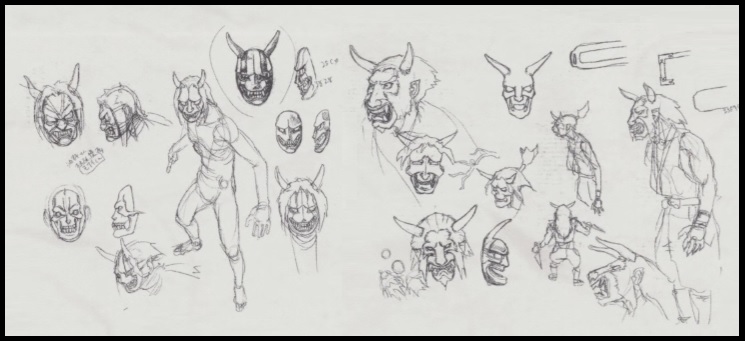
Character Design
—Who was the first character you completed?
Inoue: Probably the grunt soldiers. If you don't get the generic characters ready first, the programmers can't do their job.
—What about the main cast?
Inoue: They were designed by Wakabayashi, so I don't know the exact order. But for the boss characters, which I handled, it was the stage 1 boss, Fujimura. It just makes sense to start with the first stage.
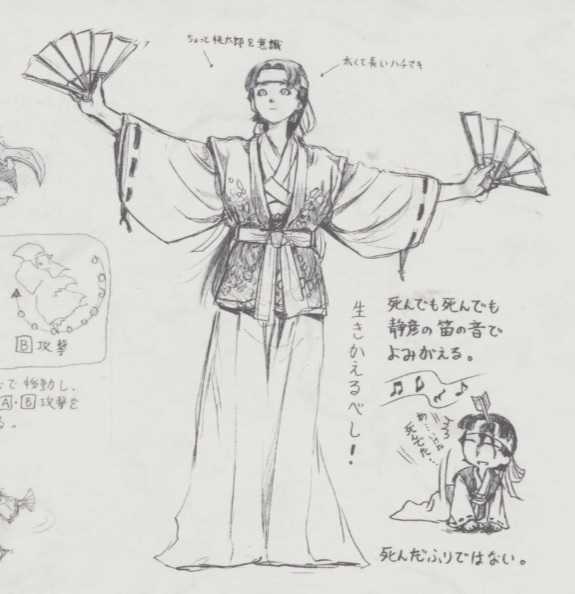
Wakabayashi (Special Appearance): For the player characters, we worked on them almost simultaneously, but if I had to pick the one who came into focus first, it would be Gensuke. Most games follow a template of "The Girl", "The Boy" and "The Weirdo." Initially, we planned for Gensuke to be 1P and Kosame to be 2P, but then we dared to make Shishin the 1P character instead.
—Conversely, which character caused the most friction during design?
Inoue: We argued constantly, so I don't remember if this was at the end or earlier, but the one that took the longest to settle on was the final boss, Amagisu. She was originally designed like an oiran courtesan, but a junior staff member said, "That's boring!" When I asked him what he'd prefer, he drew an old woman with the top half of her kimono stripped off, breasts fully exposed. I thought, "This is… incredible! I've been beaten!" But we decided that was going a bit too far. Instead, we reworked her design into its current shape, a giant baby fused to her lower torso.
—Both are bizarre! I think you're tied. (laughs) Any favorite enemy characters?
Inoue: Plenty! Like "Nyan-kumo" or "Me-me-tan"…
—???
Inoue: "Nyan Kumo" is "Cat Spider," and "Me-me-tan" is "Eye Fish." That's just what my friends and I called them, so I still use those names.
—Any ideas you were fond of that got scrapped?
Inoue: At first, I really wanted to structure Guwange like Nansō Satomi Hakkenden and have it be a game about collecting eight orbs.
—Benevolence, Righteousness, Etiquette, Wisdom, Loyalty, Trust, Filial Piety, and Brotherhood, right?
Inoue: Yeah. But IKD told me, "I can't make eight stages!" so I gave up on that early on. The stage 1 boss, Shizuhiko Fujimura, looks like Shinosuke Inusaka from Hakkenden as a remnant of that original idea.
—I see! So that's how the Five Elements concept came about.
Inoue: Five elements work perfectly for five stages. Adding the final stage made it a solid six stages in total. But schedule-wise, it was touch-and-go whether we could finish that final stage. Thanks to IKD-san's sheer determination, we somehow pulled it off.
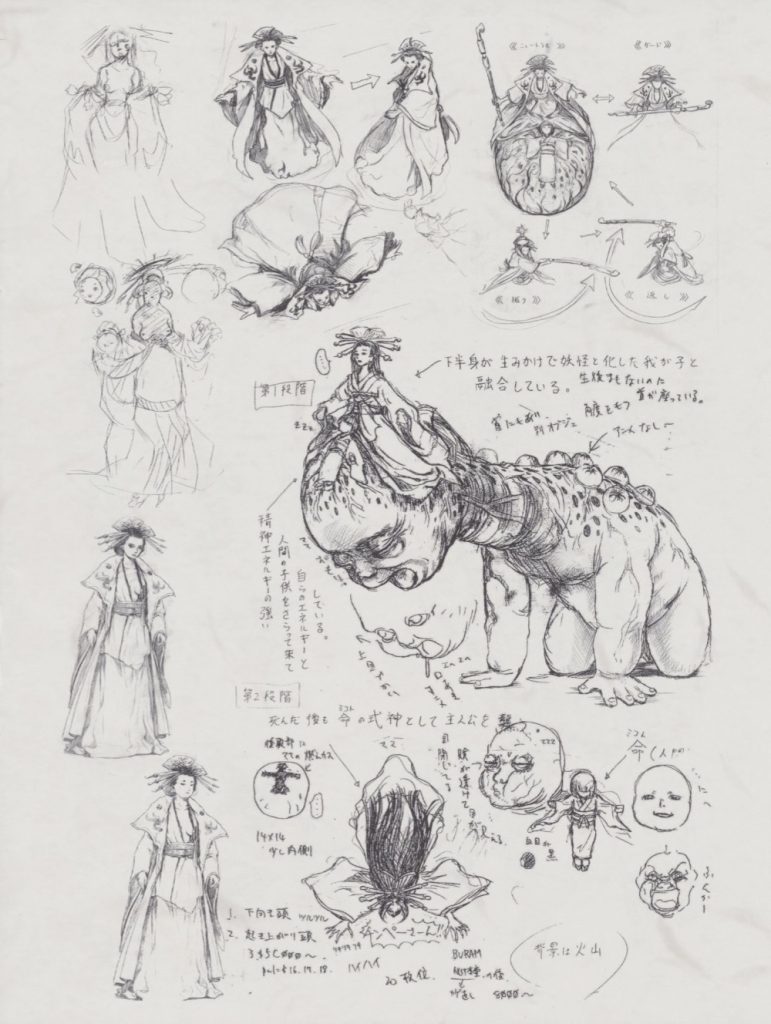
—Where did the idea for "Guwange-sama" come from?
Inoue: When I'm designing characters, basically I consider whether an idea can be expressed in a video game, and whether it's feasible to produce within our timeframe. For a final boss, ideally you want a huge character. And because production was tight, I wanted a design without too many complex moving parts. But above all, it needed the impact befitting a final boss. I also had to top that junior colleague's busty grandma. (laughs) I thought about it constantly—during my commute, while eating, even in the bathroom or bath. Ideas often strike when I'm not at my desk.
—A designer never truly gets a day off, does he?
Inoue: In a creative profession, you're basically thinking about your work every waking moment. Creators really do dedicate their entire lives to it.
—If Guwange were made into a movie, who would you cast as the leads?
Inoue: Oh, what a dream question! Just going by image… for Shishin… since he's a tall foreigner, Antonio Banderas. For Kosame, Rena Tanaka. Wakabayashi was always adamant about her. And for Gensuke, since he has that "wicked youth" vibe, maybe Ryunosuke Kamiki.
—A Japanese-American co-production! Interestingly, Banderas is actually about 5'8"—not as tall as people think! But I think everyone would be happy if Shishin had a face that handsome under his mask. What was your image for Mikoto's mother, by the way?
Inoue: Well, since she's Mikoto's mother, that would make her Shishin's wife, right? I imagine she was a beautiful Westerner, but she's most likely passed away. Otherwise I don't think Shishin would have strayed so far from the path of humanity.
—What happens to the three protagonists after the ending?
Inoue: I’d prefer for players to imagine it themselves, but in my mind, Shishin is likely destined to fight for the rest of his life. He won’t open his heart to anyone; he’ll always be feared and never find a place to truly call home. But if Mikoto is with him, she might eventually become the one to change his fate. Kosame is someone everyone loves, so I think she'll return to her village and live a happy life. Gensuke, being the ambitious sort, will probably try to exploit Mikoto (the "Blue-Eyed One") to make money. But Mikoto would never open her heart to someone like him. I sense a lot of turmoil in his future.
Favorite Scenes and Cut Content
—Is there a specific "showpiece" scene in the game you want players to notice?
Inoue: I've crammed a lot of details into places that are hard to spot. Stage 6 (Mt. Gokumon) is a parade of them. If you play it enough, you might find something new every time.
—If you had to pick just one? I can't actually reach the final stage myself... (sob).
Inoue: There's a part near the end where the gokutotsu (red demons) are chasing you and you're panicking, thinking "Let me out of here!" And just when you feel you've reached your limit, they suddenly flee. You think, "Whew, I'm safe," but then a creepy altar appears and an even stronger enemy emerges… This little drama is easy to miss unless pointed out, but I think players feel it intuitively.
—Are there any enemy or boss entrance scenes that you're particularly fond of?
Inoue: It's not so much a favorite as it is something I hope people notice: did anyone see the Cat-Spider carrying a villager in its mouth? You see it when the cat-spider first briefly appears, but the combat gets so intense right then that no one probably notices it. The programmers have the final say, so gameplay always takes priority over my art, but I think that's as it should be.
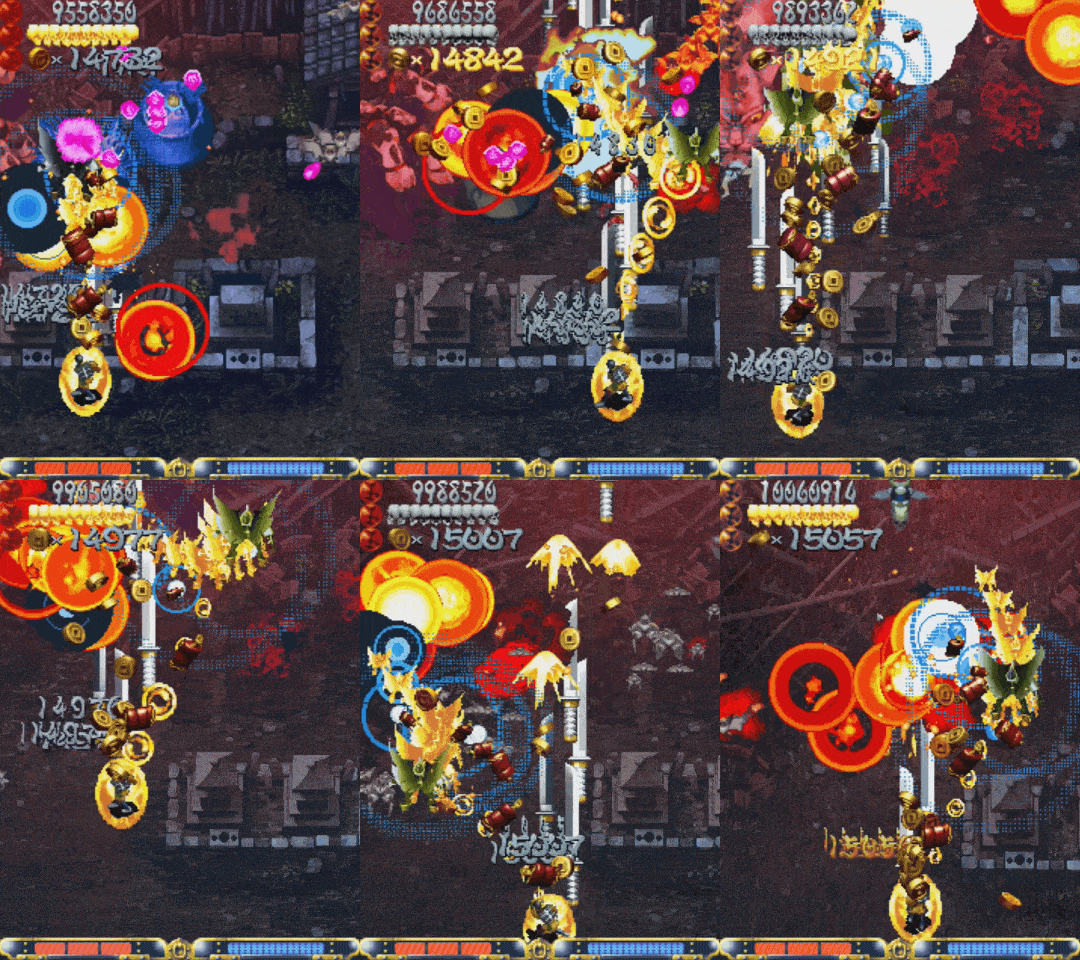
—Were there any parts where you thought, "Damn, I worked so hard on this, but it got cut!"
Inoue: Too many to remember. (laughs) In Guwange, things weren't so much "cut" as they were "hidden." The bullets and effects are so thick you can't see the character art! It's a shame, especially with small bosses like Ashikaga Sugoraji or Magira. They have all these different animation patterns, but you can't tell!
—Yeah, sadly they're obscured and hard to see... Were there any scenes that got rejected for being too gory?
Inoue: The opening demo for Shishin. I drew a black-and-white image of Shishin devouring human flesh, and the publisher got very angry with me. I had to quickly redraw it to get the version we have now.
—You're known for loving yokai. What sparked that interest?
Inoue: It was actually while making Guwange that I thought, "Hey, I might be suited for this monster stuff." After I left the company, I started drawing yokai manga, and I even got offers to do designs for yokai movies. And recently… oh, wait, that's still a secret.
—Now that you've said that much, I want to know! But I'll wait for the announcement. (laughs) Is there anything you hate or find scary?
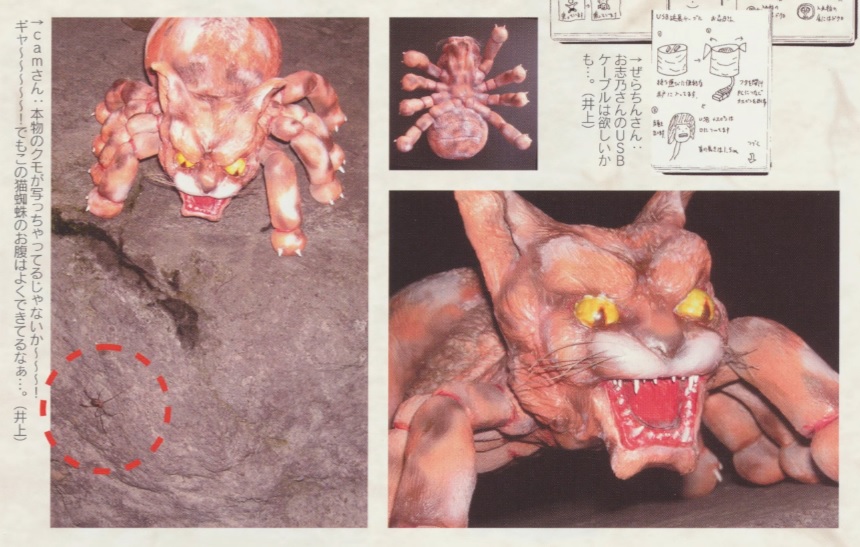
Inoue: I absolutely HATE spiders! Someone once made a figure of the Cat-Spider and sent me a photo of it next to a real (and quite large) spider. The moment I saw it, I let out a scream! I will never forgive them for that.
—Do you listen to music while you work?
Inoue: Music, yes, but lately a lot of radio. For music, I make playlists that match the image of whatever I'm working on. For Esprade, it was Avex-style tracks or overseas techno. For Guwange, it was "Japanese Techno" (which was popular in the indie scene back then) and soundtracks from Japanese films. For Deathsmiles, it was Malice Mizer and Nightwish. As for the radio, I like Ijuin Hikaru's Midnight Bakajikara. Oh, and Junji Inagawa's ghost story DVDs are great too.
—How did you end up voicing Shizuhiko?
Inoue: Back then, we didn't really think about hiring professional voice actors. We just asked employees with good, clear voices. But since we weren't pros, we'd often record something and go, "Wait... is this right?" I did Shizuhiko's voice myself because I had the strongest image of that character in my head, and I wanted to set an example and lead the team. Most regular people get shy and can't yell in front of a microphone, so I wanted to show them how it's done.
—Why Shizuhiko and not a main character?
Inoue: Wouldn't it be a bit cringe to cast myself as the lead? People would think, "How arrogant!" So I decided to take a step back and play a supporting role.
—You stood out plenty! You sounded like a pro.
Inoue: Don't say that, real voice actors will get mad at me! (blushes)
—Any ghost stories to share? Did anything strange happen during the making of Guwange?
Inoue: You always hear those rumors with horror-themed projects, right? Apparently, some teams will go to a shrine for an exorcism before they start. But since no one on the Guwange team was particularly religious, we just ignored all of that. And you know what? No curses at all! Even when I worked on the movie The Great Yokai War, the producer forgot to invite me to the blessing ceremony, but nothing happened to me. Although… the Kadokawa studio did catch fire back then. Three giant yokai props that were too big to fit in the warehouse got burned to a crisp right before filming started…

—Yikes... maybe you were saved because you aren't sensitive to spirits? If you were to make Guwange today, what kind of game would it be?
Inoue: I think it should be a dedicated home console experience. Exploring a haunted-house-style map and completing missions using various spells, with Monster Hunter style missions. That sounds like fun.
—So it would be a multiplayer game set in the same world?
Inoue: The world of Guwange still has so much untapped potential! I have endless ideas. I visited Mount Osore recently and spent two hours just staring at a lake where not a single fish lives. My mind is already primed to build the final stage of Mt. Gokumon in 3D!
—Thank you very much for your time today!

If you've enjoyed reading this interview and would like to be able to vote each month on what I translate, please consider supporting me on Patreon! I can't do it without your help!
Thanks for the translation. Very interesting. Great game in every aspect (lore, graphics, gameplay, musics, bosses/ennemies/stages)