Beyond the Revolution - Developer Roundtable Interview (2001)
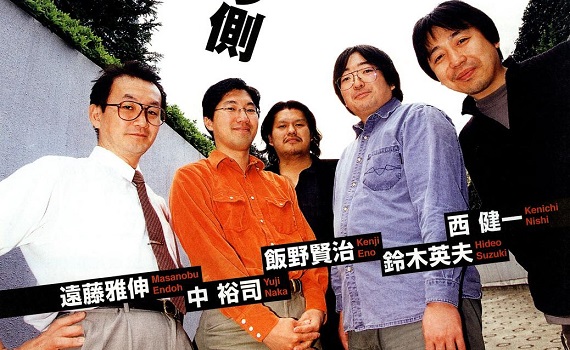
Originally published in the July 2001 issue of Famitsu DC, this roundtable discussion saw industry luminaries Masanobu Endou, Yuji Naka, Kenji Eno, Kenichi Nishi, Hideo Suzuki and Kenichi Nishi convene after Sega's announced withdrawal from the home hardware market to discuss their hopes and fears about the future of the industry and the pursuit of new ideas.
Kenichi Nishi (director, Skip)
kenji Eno (CEO, Super Warp)
Hideo Suzuki (representative director, Omiya Soft)
Masanobu Endou (representative director, Game Studio)
Yuji Naka (president, Sonic Team)
Nishi: Nishi from Skip here. Recently, I've been considering making games for PC instead of console. With console games, you'll spend a year or two working on them until they're ready for release, but you can't make any changes beyond that point — once they've been released, that's it. On the other hand, if you release on PC, you can produce version updates and so on.
Suzuki: I'm Suzuki from Omiya Soft. I've been working on a series called Culdcept for a while now… as for what I've been doing recently, I'm currently putting the final touches on the Dreamcast Culdcept game, and even as I talk to all of you right now, I'm inundated with thoughts about whether we've missed any bugs and whether the launch is going to be alright.
Endou: This is Endou from Game Studio. Most recently, we made a game called GT: Lord of Genome for the Game Boy, for which we were able to secure an unprecedently large ROM; I don't really think of it in terms of being a game so much as a platform for exploring a story, or a setting, using cards. The setting and lore is extremely detailed, to an extent that can't be fully explored within the game itself, so the setting is explained in great detail on the official website.
Naka: I'm Yuji Naka from Sonic Team. Last week, I was overjoyed to accept an award for Phantasy Star Online from the Japan Game Awards, for which I'm very grateful. I really wasn't expecting it, so all I can say is, thank you.
Nishi: The theme of today's discussion is "new types of fun", and PSO really is something special, isn't it?
Naka: Much appreciated!
Eno: I can't share any updates on my current situation (laughs). It's top secret. As you may or may not have noticed, we haven't released a game in a year and a half — if you're asking what I've been doing lately, I can say that I've been working, but I can't say anything more. If it were a game, I'd be able to make my own calls on what to say and not to say, but I can't do that for what I'm working on right now. After forming Super Warp last year, I was actually interested in making some sort of novel communication software for computers, like, say, some sort of mail service… but again, I can say no more. I mean, we should be holding a press conference soon, around summer, so I'll be able to tell you then. Simply put, it's not a game: it's a form of entertainment, but it could also incorporate games… it's complicated. Despite what many people have heard, I haven't stopped making games — I quit the game industry, but I didn't quit games, and that distinction is important.

As an aside, when the live audience asked the panel about upcoming games that excited them, they cited Sony's PlayStation 2 game Mr. Mosquito ("it's an idea everyone's thought of, but they're finally making it happen!") and Syscom's train-racing game TETSU1: Densha de Battle! (which excited Endou with the prospect of multi-track drifting.)
Nishi: Newness is, in and of itself, interesting. The Matrix offered something compelling just by presenting things in a new way, for example. Realizing these new forms of presentation is not easy, though: I might be able to picture something in my head, but can only explain it comparatively, "it's like x or y". It could be that my vision simply isn't good, but there is a degree of difficulty in trying to convey an idea for which there are not prior examples.
Suzuki: Personally, I struggle to respond when people ask me for examples of new and interesting ideas. It's a question that prods at my own ego. If I wanted to be contrarian, I'd say that the true, inherent fun of video games has already been uncovered during the frenzy of games produced after the introduction of the home computer; at that time, various patterns of games emerged, and I don't think that anything truly new has been discovered since those days. There are maybe a dozen or so different templates, if that. I'm sure all of you are pursuing new ideas, of course, so I'm merely playing devil's advocate here.
Endou: Culdcept's going to have online functionality, right?
Suzuki: Correct.
Endou: Well then, you're chasing down new ideas in that direction, no? As hardware changes, there are chances for new types of fun to emerge. that said, just because you're now able to display visible veins on a character model doesn't mean you're doing something amazing by default. Recently, I've been thinking more about how that sort of thing doesn't make the game more fun — instead of that stuff, you should just work at maintaining a frame rate of 60 frames per second. That's a core tenet of action games, I feel. Take Sonic as an example: expressing the feeling of speed can only be done by maintaining a high frame rate, so as far as that physical sensation goes, no matter how pretty the graphics are, it stops being fun if the frame rate lowers.
Naka: I'm also a stickler for 60FPS. We just announced the price and release date for Sonic Adventure 2 in yesterday's Famitsu, but the original Sonic Adventure was being produced in such a way that it could be pushed out for the launch of the Dreamcast, no matter what. The version of the game we used for on-stage presentations was running at 60FPS on actual hardware, but as we continued to adjust the game, we realized that we ultimately weren't going to be able to maintain a consistent frame rate, no matter what we did, so we reluctantly dropped it to 30FPS… it's been about two years since then, and we've been working diligently to make sure Sonic Adventure 2 holds a steady 60FPS.
Eno: When's it coming out?
Naka: It will be released on June 23—it'll be 10 years to the day since the release of the original Sonic the Hedgehog in the US on June 23, 1991. This is a milestone year… or rather, one that make me feel like I'm ageing (laughs). It's been a decade since Sonic was released to the world, and I'm deeply touched. But yes, in recent times, much like Endou-san, I've been thinking that 60FPS is absolutely essential. Nowadays, as 3D becomes the dominant form of games, more people are suffering from 3D motion sickness. In order to reduce this, we've been running various experiments, constantly toying with new methods of camera movement and so on, but avoiding motion sickness at 60FPS is not easy. PSO runs at 30FPS, but in order to prevent those with 3D motion sickness from feeling sick, both the player-character's movement speed and the speed when turning the camera is fairly slow. Keeping people from getting dizzy at 60FPS is still quite challenge, but I do think it's possible to come up with some way of keeping people from experiencing any degree of sickness.
Naka: On my part, after the Dreamcast came out, we made Samba de Amigo, and we've continued to investigate ways to incorporate body movement, or network functionality or so on. I think that in this current era, those who can observe the current trends and make a snap decision about how to move are going to come out on top. Online functionality was something Okawa really dreamt about — or to put it another way, he put everything he had into network functionality, including 200 billion yen of his own money. I'd personally insisted on including a modem with the Dreamcast and was really pleading my case, but right up until the month before the hardware was finalized, it still wasn't preinstalled, and it wasn't until the last possible moment that Okawa said, 'no, let's throw it in".
Because he made that call, we really wanted to have some sort of network-compatible game ready for the launch of the Dreamcast. However, even thought he'd granted us the modem, we didn't have a lot of time to work with it and we weren't able to utilize it in time for launch, so from there, we kept working on and studying network functionality with all our vigor. That said, it's not easy work, and it left us scratching our heads, day in and day out, and even after releasing an online-centric game, it's not over — the work continues, and nobody's able to take a break, and we were really starting to doubt whether this was the right direction to be taking.
When the Japan Game Awards were held, I went to the venue feeling casually optimistic about maybe winning the New Wave Award, but to my huge shock, out of the many big RPGs that were in contention, PSO took the main award, and I was beside myself. If I'd been able to show this to Okawa, I think he'd be the happiest of all of us. I had the trophy we were awarded placed in front of Okawa's grave. Ever since he passed, I've been contemplating so many things… The Dreamcast is, in a sense, over, but it's ending in an extraordinary fashion. Many game consoles have been phased out, but I think this is the first time that one has remained so prominent. In the midst of all this, I'm putting together PSO ver.2 and Sonic Adventure 2 and continuing to give my all to the Dreamcast. I really think that those who own a Dreamcast have found something truly special.

Eno: I don't think "new types of fun" are necessary. Anything that's stimulating is perfectly fine. There are many different kinds of stimulation, like short-term excitement or the kind that's meant to engross one over a long time, but I feel like these experiences are becoming few and far between, and there are many possible reasons as to why.
The price of game hardware has increased by so much, while the cost of software has decreased from past prices, which means that games are more difficult to produce, and the platforms themselves haven't evolved a whole lot, either. I don't think these platforms need to become more complex, necessarily, but I would like for them to offer a little more in the way of refinement. Nintendo's simple D-Pad could been pushed to greater heights if there'd been more focus on making the most of it. When the Dreamcast's microphone was released, we got Seaman, to give one example, and when the lightgun came out we got a game for that, and the fishing controller begat other games, and so on.
Nishi: On my way here today, I was thinking about the recession, or rather, the incredibly tough situation that the game industry is facing right now, and I'm starting to think more positively about how this might be a blessing in disguise. Everything is subject to the idea of optimal conditions, right? Perhaps it's reasonable for there to exist a Game Boy Advance without a Gamecube, for example, or perhaps it'd be sensible for the Dreamcast and PlayStation 2 to co-exist, but that's all determined by how many different platforms are out there, right? To begin with, those judgements are determined by the country, the era, the population, their economic power, etc; the validity of the hardware landscape is also determined by how many games can be supplied each year for each platform.
I recently had a conversation with someone in the Japanese film industry, and I came to learn that the people making movies in Japan really don't have a lot of money to work with, and that theirs is a world where it's completely commonplace to shoot V-Cinema for 20 million yen per film. People who've long operated in environments like those tend to be very bullish about finding ways to survive. They're very pro-active.
Eno: I see what you're saying. I mean, I don't really get it, but I think that makes sense.
Nishi: Yeah, I don't know. (laughs) The way we produce and create things is also in a state of flux, yeah? I definitely think that's a good thing. If we're able to return to a more reasonable state of affairs, we'll be able to begin to re-build momentum; it's not a case of maturation but rather, those studios that are able to tough it out and make a big comeback in the future will be all the stronger for it. If this process occurs, then the only games being release in 3~5 years' time will be made by those who truly love games and poured their entire lives into them.
Suzuki: When it comes to discussing both the future outlook of games and the economic concerns of the industry, I think it muddies the waters to think about them as one and the same. Sega, for instance, has been financing third-party developers to create projects that some might view as dubious, and when Sony entered the console business, they needed to be able to offer a lot of games, so they also threw their money around. From that perspective, the games industry had quite a few generous benefactors, but now Sega's primarily focused on third-party publishing and Sony has amassed a line of hit titles of their own, so the current climate is one where these big parties no longer feel the same need to spend so much money on projects from "shady" creatives. Therefore, I'd implore those people who are currently taking a progressive stance to maintain that position and continue fighting to expand the gaming landscape. The qualifications or authority to push this line aren't something that's attainable by those who are just casually operating in this space, so I think it's crucial to continue pushing boundaries.
Endou: If you want to create something new, you ultimately have to invest a lot of money into young, unproven creators who are still green, so from that perspective, outside investors are definitely important. There are still a great many parties out there who want to see and put their money behind new experiences, and truthfully, younger people aren't doing enough to gain their trust and lack the ability to properly present themselves to investors.

Eno: Speaking of networks, I'm currently exploring that space, in areas like the 100-megabit wired network that should be available soon. 100 megabits is amazingly fast and can do things in just a few seconds, and by that I mean that it'll allow players to transmit more than just controller inputs, but something much larger. I also want to make games for something other than consoles or PC, and I'm working on one such project right now — there are roughly a million of these items out there in the world, and nobody thinks of them as a gaming platform.
Naka: Oh, like a rice cooker?
Eno: Ah, don't try to guess! (laughs)
Naka: There are rice cookers out there with SH4 processors. That's the same one that's in the Dreamcast! (laughs)
Eno: Yeah, the very same. There's a pot with that same Dreamcast processor too. On that note, Zojirushi's pots are super neat, aren't they? The one they make for old people… y'know, the one that's meant to be easier for them to press? There's something in there — a PHS or something? I'm not sure, some radio-based emitter, but it's designed with the premise that old people drink a lot of tea, so when it detects that the old dude hasn't been pressing the button, it activates under the assumption that they've fallen ill or collapsed. When I learned about that, I was surprised for the first time in a while.
I think there are other ways to use network technology along those lines. For example, the average city is full of things that could operate as a server, or antennae, or a terminal for collecting and sharing data, or a hotspot that could call or broadcast to you as you pass by, and when you start to really think about it, they offer a great many possibilities. I think we creators are probably well-equipped to properly grasp these systems and then devise different play experiences that utilize them, or what kinds of compromises or limits are necessary; we might be able to invent a form of play that's truly surprising.
Changing the subject, I'm personally very disappointed that Sega's withdrawing from the home hardware business. I do think Sega will definitely create more home hardware at some point, but that it'll be completely different from what we currently think of as a game console — they're definitely going to want to break from the status quo, and I think they'll offer some sort of new game experience that nobody can imagine, so I think they're "breaking up" with us for a while so that they can work on something along those lines. Every 10 years or so, we'll enter an era where a shake-up is necessary: at that moment, I think Sega will return with something edgy, and I think it's Sega's duty to forever continue to present such edgy things, so I do think Sega's made a cool, edgy decision.
Endou: I'm also inclined to think that Sega's definitely going to release new hardware at some point.
Naka: Like Endou-san said, that's Sega. We're currently gathering our strength, but I'd definitely like to return with a Dreamcast 2 or some other new piece of hardware, so I hope you'll look forward to the day when that time comes.

If you've enjoyed reading this interview and would like to be able to vote each month on what I translate, please consider supporting me on Patreon! I can't do it without your help!
That last bit about SEGA home console hardware returning in ten years is bittersweet to read, now.